Same decision, every time. How much can you hand to
 AI?
AI?
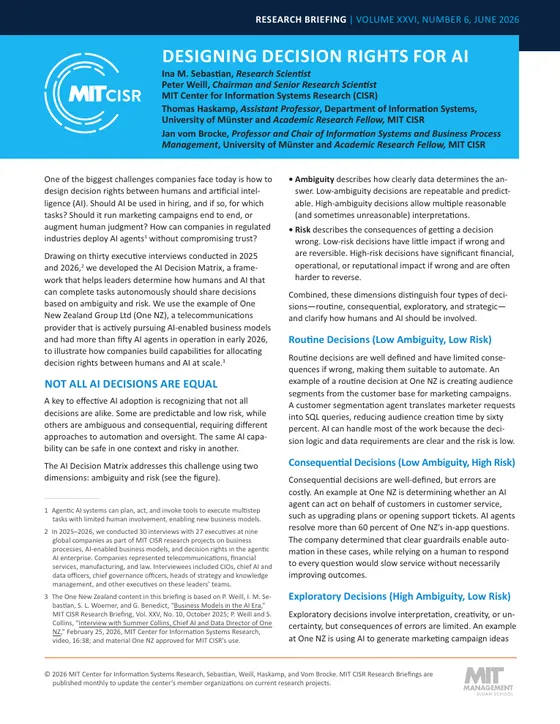
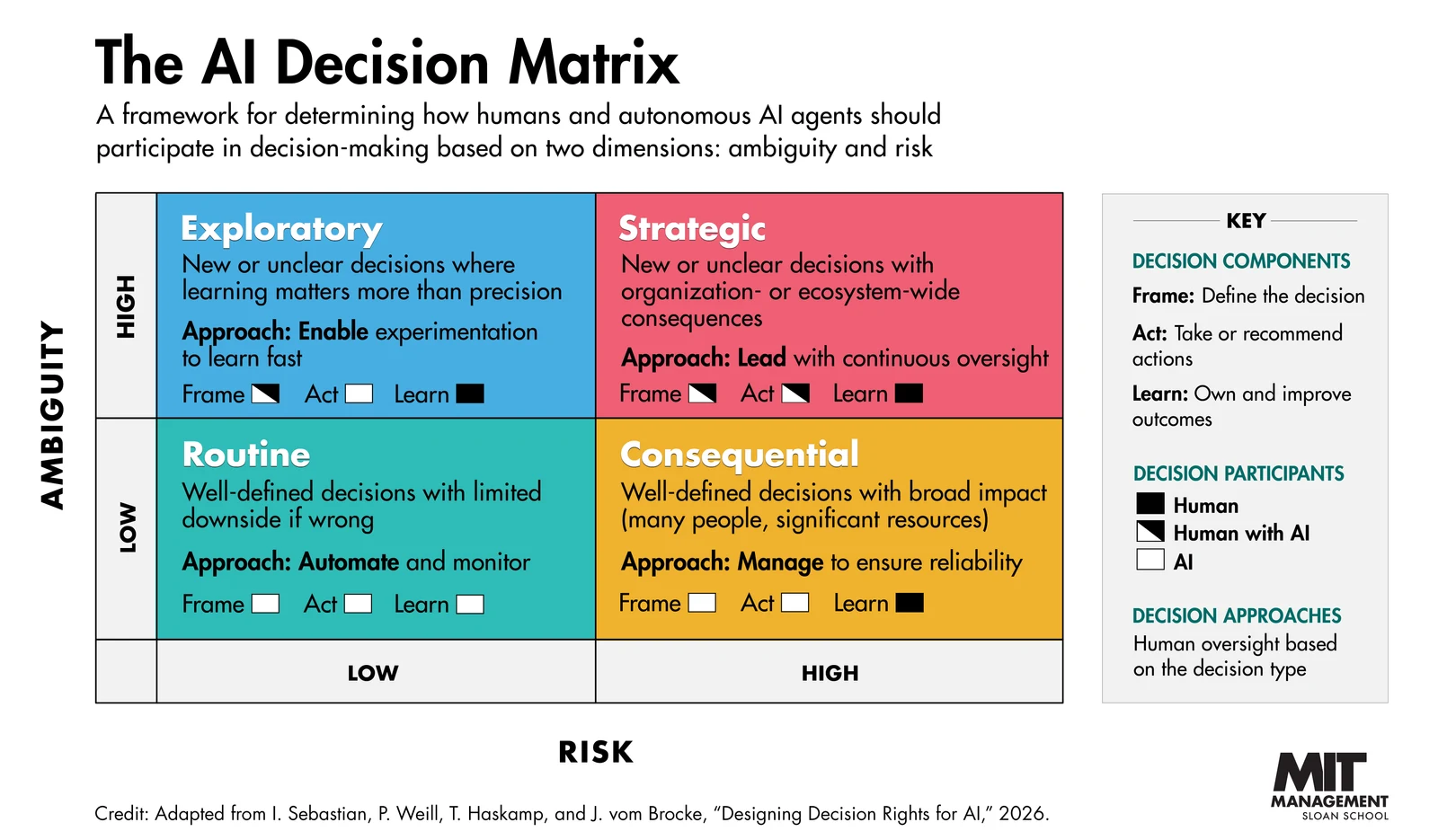
Rate one business decision on two dimensions, ambiguity and risk. The matrix places it in one of four types, and each type splits the work between people and AI differently.
Based on research by



 MIT CISR Research Briefing
The framework
Four types of decisions
Ambiguity describes how clearly data determines the answer. Risk describes the consequences of getting the decision wrong. Together they give four decision types: routine, consequential, exploratory and strategic.
Each type splits framing, acting and learning differently between people and AI.
Graphic: MIT Sloan School of Management. Read the article
Place one decision on the matrix
Describe a decision in a few sentences, or answer 20 short statements. The matrix moves with every answer, and you get a short report at the end.
Answers you gave in the questionnaire are kept. Only the ones taken from your description are updated.
Please name your decision first. It becomes the title of your report.
Your report
Not started yet
Describe a decision or start the questionnaire. Your report appears here when you finish.
- Frame
- Act
- Learn
Key facts
Show all criteria
How each answer was scored: higher means more ambiguity or more risk. Reverse-coded statements count as 6 minus the answer. Weights are test values.
Ambiguity
Risk
Designing Decision Rights for AI
Leaders have to decide how people and autonomous AI share decisions. The briefing recommends managing AI as a portfolio of business decisions rather than a collection of use cases. Routine and consequential decisions pay off now in efficiency and scale. Exploratory and strategic decisions pay off later, in innovation and better judgment.
- AuthorsIna M. Sebastian, Peter Weill, Thomas Haskamp, Jan vom Brocke
- SeriesMIT CISR Research Briefing No. XXVI-6
- PublishedJune 18, 2026
- Basis30 interviews with 27 executives at nine global companies in 2025 and 2026
Cite as
Sebastian, I. M., Weill, P., Haskamp, T., & vom Brocke, J. (2026). Designing Decision Rights for AI. MIT CISR Research Briefing, XXVI(6).